


- In stock
- Shipping in 1 to 5 business days.
€25,95
Complies with EU Plant Health Regulation
Prices including VAT
Shipping throughout Europe
5% regular customers discount
Pick up in Limburg
3000 PostNL pick-up points

- Article number: DRADRA01
Dracaene draco is an umbrella-shaped tree that can reach a height of up to 18 meters. The plant is native to the Canary Islands, Cape Verde, and Madeira. It is virtually no longer found in the wild. All specimens standing on these islands are privately owned. Nevertheless, the species is not endangered. Due to its high ornamental value, it is frequently planted on these islands, and it is also a very popular tree on the mainland.
When the bark of the tree is cut, a reddish resin flows from the wound. The color and substance of this resin are the reason the tree is called the dragon's blood tree.
It is a slow grower. Furthermore, due to the tree's growth pattern, it is difficult to determine its actual age. After all, it has no annual rings. Its age is therefore primarily determined by looking at the number of branches. Consequently, it is said that the plant can live to be as old as 1,000 years. After 10 years, it is quite possible that the tree has not yet reached a height of one meter.
The tree prefers a dry spot in full sun. Think of the conditions on Tenerife, for example, where the largest known Dracaena grows. Therefore, always ensure there is sufficient drainage. The plant must always be able to release its water. In winter, the plant cannot survive outdoors in a pot. Bringing it indoors to the garage or wrapping it up are options. However, we recommend using the dragon tree as a houseplant during the winter months. The dry winter conditions in the European living room are ideal for overwintering this plant.
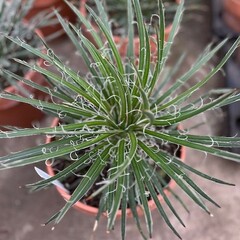
The sturdy leaves of the Dracaena can be quite sharp at the tips; also keep in mind that the Dracaena is not suitable for consumption and is even mildly toxic. Therefore, always ensure that pets or small children cannot reach it.
Winter hardiness zone 10b (1ºC).
Specifications
- Article number: DRADRA01
- Minimum temperature: 1ºC
- Location: Sunny
- Soil type: No special requirements, well permeable
- Water requirement: Slightly moist, drought tolerant
- Full ground:
- Tub plant:
- Flowering period: Non
- Origin / habitat: Canaries, Madeira
- Growth rate: Slow
- Maximum plant height: 10 meter
Reviews
No reviews found